OEM vs ODM: Choosing a Production Model by the Brand You Are Building
The OEM versus ODM decision is not a quality ranking; it is a question about which party should own the technical risk and the intellectual property. A brand built around one signature scent needs the formula to belong to it. A brand testing whether a category works for its audience is usually better served by starting from something that already exists. Most first ranges end up using both, and that is a rational answer rather than a compromise.
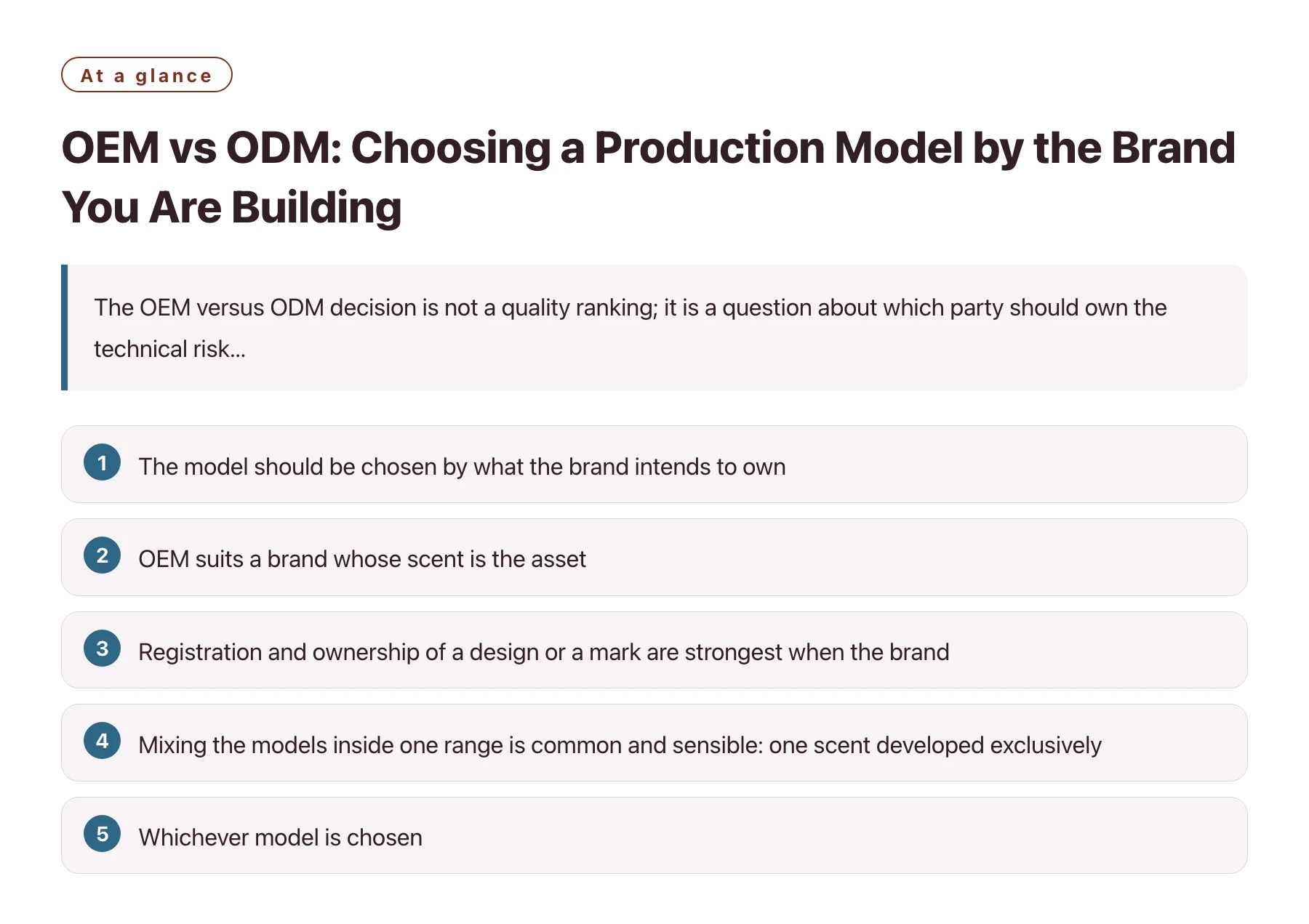
Key takeawaysThe model should be chosen by what the brand intends to own, not by which quotation arrives lower. · OEM suits a brand whose scent is the asset; ODM suits a brand whose advantage is distribution, audience or positioning. · Registration and ownership of a design or a mark are strongest when the brand, not the supplier, holds the right [1]. · Mixing the models inside one range is common and sensible: one scent developed exclusively, supporting products built on existing formats. · Whichever model is chosen, the brief should still fix concentration, fill size, packaging and destination market, because those constraints price the work either way.
Founders tend to frame this as a choice between two suppliers. It is more useful to frame it as a choice about what the brand will own in three years: the formula, the mould, the artwork files and the right to keep making the same product with someone else.
That framing also explains why the two models feel different to work with. OEM is a specification relationship — the brand defines, the factory executes. ODM is a development relationship — the factory proposes, the brand selects. Both can produce excellent products; they produce different kinds of dependency.
Ask what you intend to own, not what you intend to spend
The most useful first question is not about budget but about identity. If a customer asks what makes the product different, and the honest answer is the scent, then the scent has to be an asset the brand controls. If the honest answer is the audience, the packaging or the price point, then the formula is closer to a component than to a differentiator, and renting development is a reasonable decision.
Ownership has a legal shape as well as a strategic one. Industrial designs, marks and packaging shapes can be registered through national systems or through the international route administered by WIPO, and a registration held by a supplier protects the supplier [1]. If a design matters to the brand, the brand's name belongs on the filing.
The size of the brand also changes which constraints bite first. A smaller range often cares less about a bespoke bottle than about lower minimum quantities and faster revision rounds, which is the ground covered by what niche fragrance brands need from a factory — worth reading before the model is chosen, because it reframes what a good factory looks like.
One question sorts most projects
If the formula were published tomorrow and a competitor could copy it exactly, would the brand lose its reason to exist? A yes points towards OEM and an exclusive formula. A no points towards ODM, where speed and cost matter more than secrecy.
A versus B, by what each side accepts
| Dimension | Choose OEM when | Choose ODM when |
|---|---|---|
| Who defines the product | The brand has, or will commission, the technical definition | The brand has a brief and wants the factory to propose |
| Cost to first sample | Development is a separate project with its own budget | Development is partly reuse, so the entry cost is lower |
| Time to first sample | Longer, because the formula is being built | Shorter, because an existing base is adapted |
| Who carries technical risk | The brand, since it specified the formula | The manufacturer, since it specified the base |
| Exclusivity | Held by the brand through the formula | Purchased, and priced as an addition |
| Best fit | A scent-led brand, a repeat range, a long horizon | A category test, a fast launch, a price-led range |
The rows are listed in the order they tend to matter, not in the order they tend to be discussed. Cost appears second from the top in practice and second from the bottom in most first meetings.
Three brand profiles and the model that fits
Abstract comparisons become concrete once a brand recognises itself in one of three patterns. The patterns overlap, and a brand can move between them as it grows.
Profile one: the brand built around one scent
This brand exists because of a specific smell — one accord its founder could describe before any packaging existed. Here the formula is the product, and a shared base undermines the premise. The right structure is OEM, or ODM with exclusivity purchased and ownership transferred in writing, plus a retained reference sample both parties hold.
Profile two: the brand testing a category
This brand already sells something else — candles, skincare, apparel — and wants to know whether fragrance belongs in its range. Speed and a controlled entry cost matter more than exclusivity, and ODM is usually the better instrument. The risk to manage is not the scent being shared; it is launching six products when one would have answered the question.
Profile three: the brand extending a line
This brand has a product that sells and wants flankers, a larger format or a gift set. The formula already exists, so the work is repeatability at a new volume or in a new pack. That is OEM execution, and the important questions move to capacity, lead time and how consistent the concentrate stays across batches. A a manufacturer that supports OEM and ODM is easier to grow with here, because the same partner can hold the original formula and produce its variations.
Do not let the model stay implicit. State it in the brief, state who owns the formula and the mould, and state what happens if the brand wants to move the product elsewhere. A project that names its model early avoids the two most common disputes: a brand that assumed exclusivity, and a manufacturer that assumed it would keep the formula.
The hybrid most first ranges actually use
A first range rarely needs the same treatment for every product. A common structure is one hero scent developed exclusively, whether through OEM or through ODM with exclusivity, supported by two or three products built on existing bases and standard formats. The hero carries the identity; the supporting products carry the volume and the margin that lets the hero exist.
That structure also keeps the supplier relationship simpler. One partner can hold an exclusive formula for the hero and a shared base for the rest without the brand having to manage two contracts, two quality systems and two shipping schedules.
Keep the ownership paperwork current. When a product moves from a shared base to an exclusive one, or from an ODM launch to an OEM repeat, the change should be documented while the relationship is still friendly. In the European Union the party that places the product on the market carries obligations a supplier cannot assume, and that party is normally the brand [3]. Knowing exactly which product is which, and on what terms, is what makes that responsibility manageable.
Whichever way the first range is structured, the brief still has to fix the same four constraints — concentration, fill size, packaging and destination market. Those decide the price in both models, and they decide how much of the development can be reused by Xuelei Perfume or by any other supplier once the products are in market [2].
Sources
- WIPO — World Intellectual Property Organization —— The UN agency for intellectual property; resources on industrial design and patent protection relevant to product and packaging design.
- IFRA Standards Library (International Fragrance Association) —— The IFRA Standards Library lists the restrictions the fragrance industry applies to individual fragrance ingredients, based on safety assessments; it is the reference point for compliant fragrance formulation.
- Cosmetics Europe —— The European trade association for the cosmetics and personal care industry, publishing guidance, positions and market information.
Frequently asked questions
Can a brand use OEM and ODM at the same time?
Yes, and many first ranges do. One product is developed exclusively to carry the brand identity while supporting products use existing bases and standard formats. The two arrangements need separate terms, especially on ownership and exclusivity.
Which model is faster to launch?
ODM is usually faster because development starts from an existing base rather than from a blank page. The gap narrows when the brand already owns a formula, in which case an OEM run skips the development stage entirely.
Does OEM mean I have to hire a perfumer?
Not necessarily. Many brands commission a brief from an independent perfumer or a fragrance house and then give the finished formula to a manufacturer to produce. The point of OEM is that the technical definition is the brand's, however it was obtained.
What happens to the formula if I switch suppliers?
If the brand owns the formula and holds the documentation, it can be transferred and reproduced elsewhere. If the manufacturer developed and retained it, the brand may have to rebuild the product, which is why the ownership clause is worth settling while the relationship is new.
Is ODM only for beginners?
No. Established brands use ODM for flankers, seasonal editions and category tests where speed matters more than exclusivity of the base. The model is a tool, and it stays useful at every size of company.