Booking Mining Fees as a Cost Line, Not a Surprise
I keep the books for a two-person mining outfit, and the line that used to cause the most arguments was the pool charge. At 2,218 TH/s the gross is $84.27 a day, the listed 4% on the block-reward component comes to $3.37, and the listed 2% on the PPLNS-distributed parts comes to $1.69. Once those three numbers had their own rows, month-end stopped being a negotiation.

Key takeaways
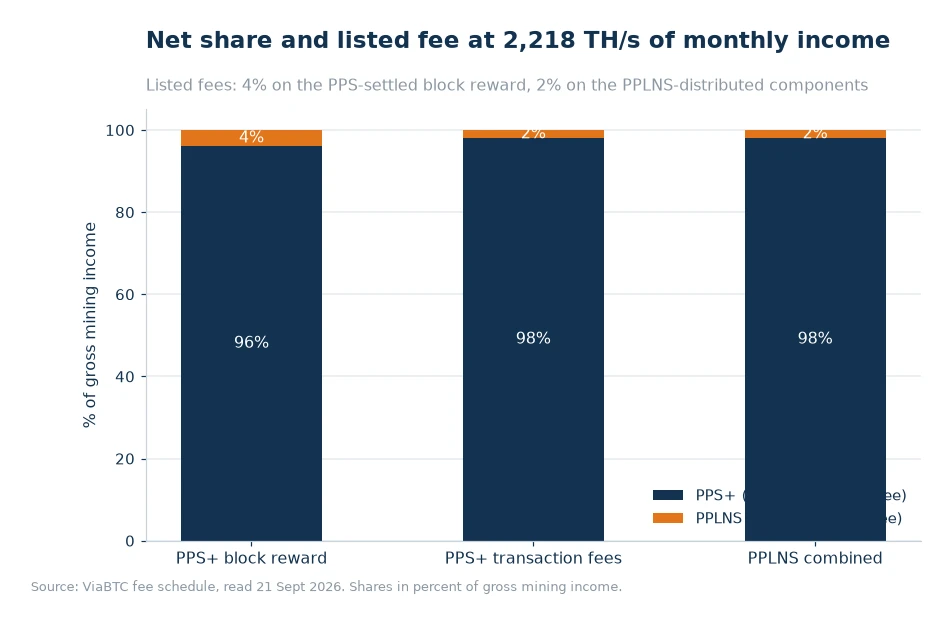
- At 2,218 TH/s the daily gross is $84.27, the listed 4% line is $3.37, and the listed 2% line is $1.69.
- Book the charge per settlement, not per month, or the reconciliation will never close.
- A 4% line is 4.0% of the block-reward base, not 4% of revenue after power and hosting.
- Keep the read date of the rate table beside the entry; six months later it is the only defence in an audit.
The invoice and the payout are two records
Every settlement produces two facts that look like one. The pool credits coins, and the pool deducts a charge before the credit. If the books record only the net figure, the charge disappears and the expense line for mining fees reads zero at year end. That is not a small bookkeeping preference; it changes the reported cost base and makes the operation look more profitable than it is.
My fix was a two-line entry per settlement. One line records gross mining income, the other records the fee as an expense. The bank or wallet sees only the difference, which is why the two lines need to exist in the ledger rather than in a note attached to it. Anyone who has tried to reconstruct a year of charges from wallet history knows how badly this goes.
Splitting the charge by component
The charge is not one number and should not be one account code. PPS+ settles the block-reward portion at a listed 4% and the transaction-fee portion at a listed 2% under PPLNS logic. PPLNS as a standalone mode applies a listed 2% to the combined total. Three bases, two rates, one account.
In practice I use two sub-accounts: fee on block reward, fee on fee revenue. It looks fussy for a small operation, and it takes about four minutes a week. In exchange, when someone asks whether the fee is eating a growing share of income, the answer is a column rather than an opinion. That is worth four minutes.
A ledger row per settlement
The table shows the shape I post, with the 4% planning line applied to the daily gross. Day 1 and day 7 are ordinary settlements; the final row is the month-end roll-up.
| Entry | Gross credited | Listed fee | Net credited | Cumulative net |
|---|---|---|---|---|
| Day 1 | $84.27 | $3.37 | $80.90 | $80.90 |
| Day 7 | $589.89 | $23.60 | $566.29 | $566.29 |
| Day 30 roll-up | $2,528.10 | $101.12 | $2,426.98 | $2,426.98 |
The cumulative column restarts each month on purpose. A rolling balance that never resets hides the month in which something went wrong, and the whole point of keeping these records is to find that month while it is still recent enough to investigate.
Reconciling the fee against the schedule
Once a month I take the actual charge, divide it by the actual gross, and compare the result with the rate I expect. At this hashrate the 4% line on $2,528.10 is $101.12. If the books show $105 instead, something changed: a different mode, a different component mix, or a rate update I missed.
The ViaBTC Pool Fees page is the reference for that comparison, and I print the read date at the top of the reconciliation sheet. A rate table without a date is not evidence. It is a memory of a page, and memories are what auditors are paid to doubt.
What a 4% line does to a margin sheet
A 4% charge on gross income is not a 4% reduction in profit. If the operation runs at a 15% margin, the same charge removes roughly a quarter of it. That is the sentence I keep in the cover note of the monthly pack, because it is the one figure that makes the fee feel proportional to the business rather than to the invoice.
Run it at this hashrate. Gross is $2,528.10 for thirty days. Power and hosting take their share, say $2,150, leaving $378.10 before the fee. The fee at $101.12 cuts that to $276.98, a 27% reduction in what remains. Same 4%, very different weight, depending on which denominator you choose.
Audit trail habits worth keeping
Three habits carry most of the value. Save the daily settlement export as a file with the date in its name. Record the rate table read date next to the reconciliation. And write a one-line note whenever the settlement mode changes, because a mode change is the only common event that shifts the effective charge without any rate changing.
The fourth habit is boring and saves the most time: keep the mining wallet separate from the operating account. The multi-currency wallet holds the credited coins, and the operating account receives only what gets converted. When the two are mixed, every transfer becomes a judgement call and the fee line gets buried under them.
Keep a folder for the rate table itself. Not a link, a saved copy with the access date in the filename. Rates change rarely, which is exactly why a change is easy to miss and hard to date later. When a charge jumps and no rate moved, the folder proves it in seconds and the investigation moves to the component mix where it belongs.
Worked example
Post the 2,218 TH/s case exactly as the ledger would carry it.
- Hashrate in gigahash: 2,218 TH/s = 2,218,000 GH/s.
- Network share: 2,218,000 ÷ 1,003,107,267,295 = 0.0000022111.
- Daily coins: 0.0000022111 × 450 = 0.00099499 BTC.
- Gross at $84,692: 0.00099499 × 84,692 = $84.27.
- Listed 4% on the block-reward component: 84.27 × 0.04 = $3.37.
- Net for the day: 84.27 − 3.37 = $80.90.
- Thirty days: 84.27 × 30 = $2,528.10 gross, 3.37 × 30 = $101.10 to $101.12 of charge depending on rounding, and $2,426.98 net.
The rounding note is not pedantry. My sheet carries the fee to two decimals and the gross to two decimals, so a month of additions can drift by a cent or two against the daily rate multiplied by thirty. I reconcile to the settlement export rather than to the multiplication, and I note the difference so the next person does not reopen the question.
Frequently asked questions
Should mining fees be an expense or a deduction from revenue?
Either treatment can be consistent, but pick one and keep it for every settlement. I record gross income and a separate fee expense, which keeps the charge visible and makes the effective rate easy to compute each month.
How do I check the charge without exporting everything?
Take one day, multiply the gross by the listed rate for the component, and compare with the settlement line; at 2,218 TH/s a day of gross is $84.27 and the listed 4% line is $3.37.
What if the fee percentage looks higher than expected?
Check the component mix and the settlement mode first. A shift toward transaction-fee revenue or a switch between PPS+ and PPLNS changes the effective rate without any published rate moving.
Close the month with the fee booked
Before the pack goes out, confirm three figures match: the settlement export, the fee sub-accounts and the reconciliation sheet. If all three agree, sign it and move on. If one disagrees, find the day rather than adjusting the total, because an adjustment hides the cause and the same gap will reappear next month. The Profit Calculator gives a quick independent check on the gross, and the settlement export remains the record of what was actually paid.
Sources: viabtc.com fee schedule, wallet and calculator pages. The 21 Sept 2026 figures used were 1,003 EH/s, 132.76 T difficulty, $84,692 for one BTC and a 3.125 BTC reward across 144 blocks each day[1]. Ledger rows assume no downtime. Published 24 Oct 2026.