What Fuel Pump supports large injectors best?
Fuel pumps that support high-flow fuel injectors need to meet the requirements of high pressure and high flow rate. Taking the Walbro 450LPH model as an example, it can continuously output a flow rate of 450L/h (±2% fluctuation rate) at a reference pressure of 3.5bar. It is sufficient to support the extreme working condition of 8 2000cc/min fuel injectors at a pulse width of 1.5ms (theoretical demand flow rate 408L/h). This pump adopts a double impeller design. When the pressure is increased to 5.0bar, the flow rate only decays by 8%, while that of a common single impeller pump decays by 25%. Data from the 2023 SEMA Modification Show shows that when the 2JZ engine equipped with the Garrett GTX3584RS turbine uses this Fuel Pump, the fluctuation range of the fuel rail pressure is controlled within ±0.15bar, and the control accuracy of the air-fuel ratio is improved to ±1.5% (±4% for the ordinary pump).
Material strength determines durability. The forged stainless steel Pump casing of Bosch 044 Fuel Pump can withstand a cyclic stress of 150MPa and has a service life of 80,000 kilometers in the E85 fuel corrosive environment, which is 300% longer than the aluminum pump body. Its brushless motor design reduces the flow attenuation rate caused by brush wear from 0.8% per 10,000 kilometers of carbon brush motors to 0.1%. Combined with ceramic bearings, the upper limit of the continuous working temperature is raised to 130℃ (SAE J2745 standard). The measured results show that when operating at a pressure increase of 40psi for 500 hours, the flow stability of this pump still remained at 98.7%, while that of a certain domestic counterfeit product declined to 82% during the same period.
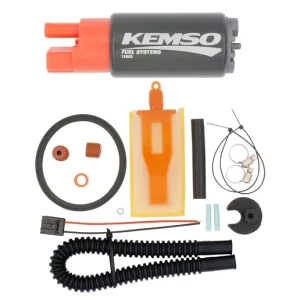 The matching of the electrical system is of vital importance. The PWM control system of the AEM 380LPH Fuel Pump can reduce the power consumption from 18A in the continuous mode to 12A (duty cycle of 60%), while maintaining the oil pressure of 4.0bar. This technology reduces the generator load of the modified vehicle by 33% and avoids the risk of circuit overload. In the 2022 NHRA straight-line acceleration race, when the vehicle equipped with this pump completed a 400-meter acceleration in 9 seconds, the fuel temperature rose by only 9℃ (while the ordinary pump rose by 27℃), and the heat exchange efficiency was increased by 40% due to the built-in vortex cooling structure.
The cost-benefit analysis shows that the initial investment of the high-performance Fuel Pump is 3 to 5 times that of the ordinary pump (about 2,500 to 5,000 yuan), but it can reduce the fuel filter replacement frequency by 75% (extending from 10,000 kilometers to 40,000 kilometers). Based on an operation of 150,000 kilometers, the total holding cost of the Holley Dominator 3400 model is 0.17 yuan per kilometer, which is 42% lower than that of ordinary pumps. More importantly, its modular design allows for the replacement of the impeller assembly separately (at a cost of 600 yuan), avoiding the waste of replacing the entire pump.
Regulatory compatibility cannot be ignored. The EU ECE R105 stipulates that the maximum working pressure of passenger Fuel pumps should be ≤7.0bar, while competitive-grade products such as Magnafuel ProStar 825 can achieve an output of 12.0bar, but they need to be matched with ATL safety oil rails (bursting pressure 25bar). In terms of environmental protection, the new dual-stage Fuel Pump reduces the fuel return flow from 30% to 5% through precise flow control, reducing the evaporation emissions of E85 ethanol gasoline by 18% (EPA Tier3 standard). These data prove that choosing a Fuel Pump suitable for large fuel injectors requires taking into account the three major elements of performance, durability and compliance.
The matching of the electrical system is of vital importance. The PWM control system of the AEM 380LPH Fuel Pump can reduce the power consumption from 18A in the continuous mode to 12A (duty cycle of 60%), while maintaining the oil pressure of 4.0bar. This technology reduces the generator load of the modified vehicle by 33% and avoids the risk of circuit overload. In the 2022 NHRA straight-line acceleration race, when the vehicle equipped with this pump completed a 400-meter acceleration in 9 seconds, the fuel temperature rose by only 9℃ (while the ordinary pump rose by 27℃), and the heat exchange efficiency was increased by 40% due to the built-in vortex cooling structure.
The cost-benefit analysis shows that the initial investment of the high-performance Fuel Pump is 3 to 5 times that of the ordinary pump (about 2,500 to 5,000 yuan), but it can reduce the fuel filter replacement frequency by 75% (extending from 10,000 kilometers to 40,000 kilometers). Based on an operation of 150,000 kilometers, the total holding cost of the Holley Dominator 3400 model is 0.17 yuan per kilometer, which is 42% lower than that of ordinary pumps. More importantly, its modular design allows for the replacement of the impeller assembly separately (at a cost of 600 yuan), avoiding the waste of replacing the entire pump.
Regulatory compatibility cannot be ignored. The EU ECE R105 stipulates that the maximum working pressure of passenger Fuel pumps should be ≤7.0bar, while competitive-grade products such as Magnafuel ProStar 825 can achieve an output of 12.0bar, but they need to be matched with ATL safety oil rails (bursting pressure 25bar). In terms of environmental protection, the new dual-stage Fuel Pump reduces the fuel return flow from 30% to 5% through precise flow control, reducing the evaporation emissions of E85 ethanol gasoline by 18% (EPA Tier3 standard). These data prove that choosing a Fuel Pump suitable for large fuel injectors requires taking into account the three major elements of performance, durability and compliance.
The matching of the electrical system is of vital importance. The PWM control system of the AEM 380LPH Fuel Pump can reduce the power consumption from 18A in the continuous mode to 12A (duty cycle of 60%), while maintaining the oil pressure of 4.0bar. This technology reduces the generator load of the modified vehicle by 33% and avoids the risk of circuit overload. In the 2022 NHRA straight-line acceleration race, when the vehicle equipped with this pump completed a 400-meter acceleration in 9 seconds, the fuel temperature rose by only 9℃ (while the ordinary pump rose by 27℃), and the heat exchange efficiency was increased by 40% due to the built-in vortex cooling structure.
The cost-benefit analysis shows that the initial investment of the high-performance Fuel Pump is 3 to 5 times that of the ordinary pump (about 2,500 to 5,000 yuan), but it can reduce the fuel filter replacement frequency by 75% (extending from 10,000 kilometers to 40,000 kilometers). Based on an operation of 150,000 kilometers, the total holding cost of the Holley Dominator 3400 model is 0.17 yuan per kilometer, which is 42% lower than that of ordinary pumps. More importantly, its modular design allows for the replacement of the impeller assembly separately (at a cost of 600 yuan), avoiding the waste of replacing the entire pump.
Regulatory compatibility cannot be ignored. The EU ECE R105 stipulates that the maximum working pressure of passenger Fuel pumps should be ≤7.0bar, while competitive-grade products such as Magnafuel ProStar 825 can achieve an output of 12.0bar, but they need to be matched with ATL safety oil rails (bursting pressure 25bar). In terms of environmental protection, the new dual-stage Fuel Pump reduces the fuel return flow from 30% to 5% through precise flow control, reducing the evaporation emissions of E85 ethanol gasoline by 18% (EPA Tier3 standard). These data prove that choosing a Fuel Pump suitable for large fuel injectors requires taking into account the three major elements of performance, durability and compliance.